
More Silver Isn’t Always Better: What PPM Really Means in Colloidal Silver for Pets
Posted by Jewel on Aug 31, 2026
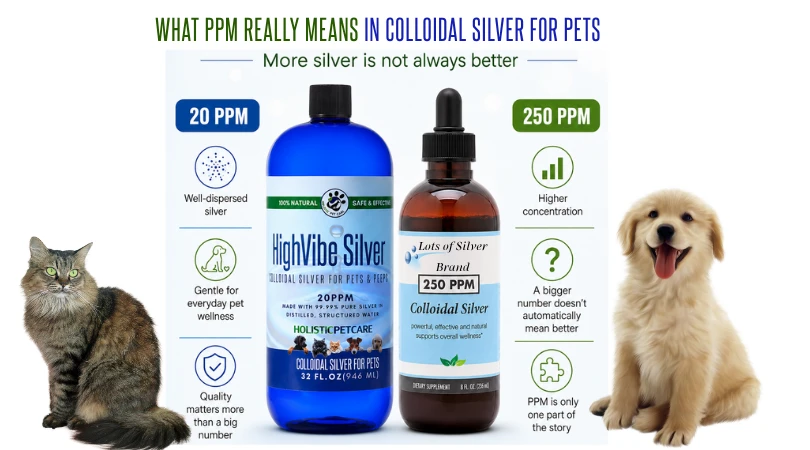
If you shop for colloidal silver these days, you may see products boasting 50 ppm, 100 ppm, 250 ppm, 500 ppm, and even higher concentrations.
It certainly sounds impressive.
If 20 ppm is good, wouldn't 250 ppm have to be better?
Not necessarily.
This is something I've been studying and working with for many years through Holistic Pet Care, and I think pet parents deserve to understand what that number on the bottle actually means.
PPM simply means "parts per million." In a water-based product, it basically tells us the total concentration of silver in that liquid. A 20 ppm solution contains roughly 20 milligrams of silver per liter, while a 250 ppm solution contains roughly 250 milligrams per liter.
So yes, 250 ppm contains considerably more silver per ounce of liquid.
But here's the important part.
PPM does not tell us the number of individual silver particles, their size, how well they remain dispersed in the water, how much surface area is available, or how much bioactive silver ion is released.
And those things matter.
Research on silver nanoparticles has found that antimicrobial activity depends on several characteristics, including concentration, particle size, shape, exposed surface area, surface chemistry, aggregation, and the availability of silver ions. In fact, researchers have found that antimicrobial activity can sometimes correlate better with available silver surface area than with silver concentration by weight alone.
This is very close to what I was taught years ago about colloidal silver.
It isn't simply about putting the greatest possible quantity of silver into the water. What matters is how much active silver is actually available to come into contact and interact with microorganisms.
I sometimes describe this more simply as having many tiny silver particles surrounding or coming into contact with the pathogen.
Scientifically, a more accurate way to describe that idea would be available surface area, dispersion, contact with microorganisms, and silver-ion release.
Smaller, well-dispersed particles can provide much more exposed surface area relative to their mass than larger particles. Research on nanosilver has repeatedly shown that particle size and surface area can strongly influence antimicrobial activity.
That is why I don't judge colloidal silver by the ppm number alone.
Some companies selling very high-ppm silver emphasize that their products contain many times more silver per serving and therefore allow the consumer to use a smaller amount. They may also promote the concentrated product as being more economical because a bottle can last longer. That is a legitimate concentration argument. More ppm does mean more total silver in the same volume.
But that is not the same thing as demonstrating that 250 ppm is therapeutically superior to a well-made 10 or 20 ppm colloidal silver.
Those are two very different statements.
I think this is where marketing can get ahead of the science.
A large number printed on the front of a bottle is easy for consumers to understand. Bigger sounds stronger.
But colloidal science is more complicated than that.
There is actually laboratory research showing antimicrobial activity at surprisingly low silver concentrations. In one study comparing different silver nanoparticle and silver-ion preparations against several bacteria, minimum inhibitory concentrations, meaning the amounts that stopped bacterial growth in the laboratory, ranged from about 4.6 to 20.8 ppm. The concentrations required to actually kill the bacteria varied more widely depending upon the organism and the particular silver preparation.
That does not mean that drinking 10 or 20 ppm silver will produce those same results inside a dog or cat.
A laboratory dish and a living animal are completely different environments.
But it does demonstrate something important: antimicrobial activity is not automatically dependent upon having hundreds of parts per million of silver.
At the same time, I don't think it would be scientifically accurate to say that ppm doesn't matter at all.
It does matter.
All else being equal, increasing the concentration gives you more silver. Laboratory studies often find stronger antimicrobial effects as silver concentration increases.
The mistake is assuming that concentration is the ONLY thing that matters.
Think of it this way.
Imagine I gave you a pound of ice.
It could be one giant block of ice, or it could be thousands of tiny pieces of crushed ice.
The weight is exactly the same, but the crushed ice has vastly more surface exposed to everything around it.
Silver particles can behave somewhat similarly. Two preparations containing the same amount of total silver can behave differently depending upon particle size, surface area, ionic content, stability, and how those particles are dispersed.
That is why when someone tells me that their silver must be better simply because it is 250 or 500 ppm, my next question would be:
What else do you know about it?
What is the actual particle-size distribution? How much is ionic silver versus particulate silver? How stable is the colloid? Does it aggregate over time? How pure are the water and silver? Has an independent laboratory actually characterized the finished product?
Interestingly, one laboratory analysis of 14 commercially available products found that many products marketed as "colloidal silver" were actually primarily ionic silver rather than suspensions containing measurable silver nanoparticles.
So the number on the front of the bottle doesn't tell the entire story.
This is especially important to me when we are talking about our pets.
More silver is not automatically desirable simply because more sounds more powerful.
If the same volume of a 250 ppm product is given instead of a 20 ppm product, the animal is receiving substantially more total silver.
And because there is no scientifically established oral therapeutic dose of colloidal silver for treating infections in dogs and cats, I don't believe pet parents should be encouraged to chase increasingly high ppm numbers under the assumption that stronger automatically means safer or more effective.
The FDA has specifically taken regulatory action against companies marketing colloidal silver products with claims that they treat or prevent diseases in animals because those products have not gone through the animal-drug approval process establishing safety and effectiveness for those uses.
That is also why I think it's important to distinguish between what we know about silver itself and what has actually been proven about orally administered colloidal silver in pets.
Silver absolutely has recognized antimicrobial properties.
Veterinary medicine itself uses silver compounds and silver-containing dressings for certain topical applications and wound care. The Merck Veterinary Manual describes antimicrobial activity from silver ions and silver nanoparticles and notes that particle characteristics and the amount of bioactive silver available influence their activity.
That is very different from saying that increasingly concentrated oral colloidal silver has been proven to treat infections inside an animal.
We simply don't have that evidence.
This is one reason I have continued to make our HighVibe Silver at 20 ppm.
I am not claiming that science has declared 20 ppm to be the perfect concentration for every possible use. It hasn't.
My point is much simpler.
I don't see a good reason to assume that 250, 500, or 1,000 ppm is automatically "better" for a pet simply because the number is bigger.
I would much rather look at the quality of the silver, particle characteristics, purity, consistency, and the overall amount of silver an animal is being exposed to.
And for me, holistic health has never been about believing that more of something must be better.
The body usually doesn't work that way.
More herbs aren't automatically better.
More supplements aren't automatically better.
More vitamins aren't automatically better.
And more silver isn't automatically better either.
The goal is balance.
When I choose products for my own animals and when I formulate products for Holistic Pet Care, my philosophy has always been to use what I believe is enough without assuming that stronger and stronger concentrations automatically create better health.
So when you see that giant "250 PPM" or "500 PPM" printed on a bottle, look beyond the number.
Ask what that number actually tells you.
Because ppm tells us how much silver is there.
It does not, by itself, tell us how good the silver is.
And it certainly doesn't prove that a high-ppm product will work better for your pet.
Sometimes a very big number is useful science.
And sometimes it is simply very effective marketing.
Written by Jewel
HolisticPetCare.com